

Category: Special Edition | Reading time: approx. 9 minutes
A few weeks ago I recorded a conversation with a friend and fellow psychiatrist, Dr. Agam Dhawan, that we jokingly titled “Two MDs Who Don’t Hate NPs.”
We laughed because we knew the title alone would probably generate comments from every direction.
And that’s where we’ve arrived in healthcare. It sometimes feels like every discussion has to become an us-versus-them debate. Physicians versus nurse practitioners. Psychiatrists versus therapists. Hospital-employed clinicians versus private practice owners. The longer I’ve been in medicine, the more convinced I’ve become that these conversations are often missing the real issue entirely.
This post is my attempt to lay that out clearly — because I think it matters. And because most of what I want to say came directly out of that conversation with Agam.
We’re Arguing With Each Other While Someone Else Is Changing the Rules
There are legitimate conversations to be had about training standards, supervision, scope of practice, and education. Those are important discussions, and pretending otherwise doesn’t help anyone. I want to say that up front.
At the same time, I’ve noticed something interesting. The loudest arguments almost always happen between clinicians who all want the same thing: better patient care. Meanwhile, many of the decisions that have the greatest impact on how we actually practice medicine are being made somewhere else entirely.
Private equity firms continue buying practices. Large healthcare systems continue consolidating. Productivity expectations continue rising. Appointment times continue shrinking. Clinicians are expected to see more patients, document more thoroughly, and somehow provide better care with fewer resources than ever before.
If we’re not careful, we end up spending our energy arguing with one another while the systems creating these pressures remain completely unquestioned.
Agam put it this way when we talked about why the industry seems to like it when we fight:
“The private equity people, they’re happy that we fight. The hospital admin, they’re happy that we fight. Because then we don’t look up. We look at each other, and we keep squabbling, and they keep siphoning off the top from us.”
Read that again. It’s exactly what’s happening.
The Incentives Are Pointing in the Wrong Direction
One part of our conversation really stuck with me.
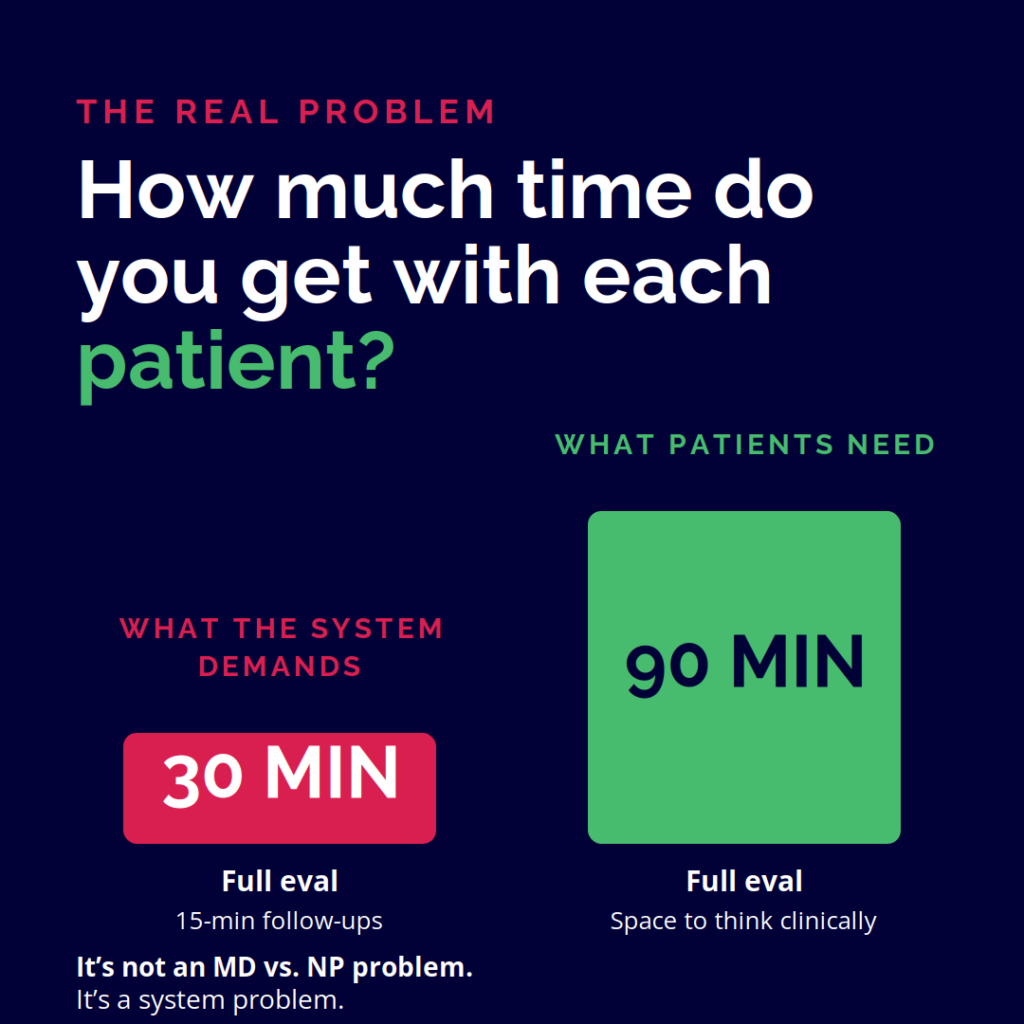
Agam shared the story of a psychiatric nurse practitioner in his program who was expected to complete thirty-minute psychiatric evaluations and fifteen-minute follow-up appointments. As he pointed out, it’s difficult for anyone to provide excellent psychiatric care under those circumstances, regardless of the letters after their name.
“I do 90 minutes with my patients. How can anyone judge your clinical skill even fairly? You’re not even set up for success if you can only do a 30-minute eval and then a 15-minute follow-up.”
When I heard that, my first thought wasn’t “that’s an NP problem.” It was: “that’s a system problem.”
I’ve seen psychiatrists put in almost identical situations. I’ve spoken with physicians who feel pressured to move patients through so quickly that they barely have time to think, let alone practice the kind of thoughtful, relational psychiatry they trained to provide. When clinicians are placed in impossible environments, we shouldn’t be surprised when patient care suffers.
The frustration is real. It’s just being aimed in the wrong direction.
The Training Problem Is Real — And It’s Not the Trainees’ Fault
Something I want to be careful about here: acknowledging that mentorship helps everyone doesn’t mean pretending the training pathways are identical. They’re not.
Psychiatry residency provides thousands of hours of immersive clinical training that simply isn’t replicated elsewhere. There’s a reason it’s called a residency — we lived in the hospital. That immersion, that volume of cases, that structured didactic curriculum — those hours build clinical judgment in a way that’s hard to substitute for.
And there’s a very real problem in NP education, particularly in psychiatry. Agam described it directly: many NP schools are essentially running as diploma mills. Students are cranked out. Programs don’t always find preceptors for their own trainees. Curriculum leans heavily on leadership and administration essays rather than the deep clinical training students are actually paying for and expecting.
Then those graduates enter jobs that expect them to already know psychiatry — and don’t provide meaningful mentorship or supervision to fill the gap.
“The schools have left them behind, and now their jobs are basically offloading training responsibilities. So they get stuck in this middle ground.”
That’s not a nurse practitioner problem. That’s an educational system that’s designed for profit, wrapped inside a hiring system that’s designed for productivity. The clinicians who go through it are the least responsible for its structure and the most affected by its consequences.
And this is why the reflexive “NPs are the problem” framing bothers me. It’s aimed at the wrong target. The people who set up these training programs, who profit from them, and who fill jobs with underprepared graduates because it’s cheaper — they are not the same people being trolled online.
The Question We Should Actually Be Asking
One of the comments Agam made in our conversation made me laugh, because it was both funny and true. He said whenever physicians tell him they’re worried nurse practitioners are going to “take all the patients,” his response is:
“Have you gone outside and touched grass?”
His point wasn’t to dismiss legitimate concerns about training. It was to remind us of a basic reality: the demand for mental healthcare in this country is extraordinary.
Every day, patients wait weeks or months for appointments. Emergency departments struggle to find psychiatric beds. Communities across the country have far too few mental health professionals to meet the need. Scarcity of clinicians isn’t our biggest problem. Access is.
When I look at the current mental health landscape, I don’t see too many clinicians. I see too many patients who still can’t get care.
So when psychiatrists frame the conversation as “NPs are going to take our patients,” I want to gently push back and ask: which patients, exactly? Because from where I’m sitting, there are more people who need psychiatric care than there are clinicians of any credential to see them. Multiple times over.
A Different Frame: Mentorship Over Tribalism
One of the things I appreciated most about our conversation was that neither of us argued the training pathways are identical. But we did agree that learning doesn’t stop after residency.
If I look honestly at my own career, a tremendous amount of what has shaped me as a psychiatrist was learned after graduation. It came from mentors, colleagues, conferences, books, difficult cases, mistakes, and years of continued study. Roughly 80% of what I know clinically, I learned after training was technically “done.”
That realization changes the way I think about mentorship, and I think it should change the way the whole field thinks about it.
Instead of asking whether another clinician “deserves” support, I find myself asking a different question: if helping another clinician become more skilled ultimately benefits patients — why wouldn’t we do that?
Agam made the same point from a slightly different angle. He described one of his NP students who received a case for a second opinion from an MD psychiatrist. She had a clear clinical opinion. She was correct. But she was so afraid the psychiatrist would dismiss her observations because of her credentials that she couldn’t bring herself to pick up the phone and discuss the case.
The patient suffered for that fear. And that fear didn’t come from nowhere — it came from the culture we’ve built.
Agam runs a mentorship program called Level Up Psych Academy, where he teaches psych NPs the clinical foundations, psychopharmacology, and case-based reasoning that many of them didn’t receive in school. If you know an NP who’s looking for that level of support, his community is here.
Leadership Looks Different Than Competition
One of the reasons I encourage psychiatrists to build private practices isn’t just about autonomy or income.
It’s because private practice creates opportunities to lead. To mentor. To teach. To create clinical environments where people — both patients and clinicians — have the time, support, and resources to practice thoughtfully.
Medicine needs more clinicians who are willing to raise the standard rather than simply criticize it. That’s true whether you’re mentoring a new psychiatrist, collaborating with a therapist, supervising a trainee, or supporting a psychiatric nurse practitioner who genuinely wants to become a better clinician.
At the end of the day, our patients don’t benefit when clinicians spend their energy protecting turf. They benefit when experienced clinicians share what they’ve learned. Full stop.
Keep Your Eyes on the Real Mission
Healthcare will continue to change. There will always be debates about policy, reimbursement, regulation, and scope of practice. Those conversations matter, and I don’t want to minimize them.
But I hope we never lose sight of why most of us entered this profession in the first place.
We didn’t choose psychiatry because we wanted to win arguments on the internet. We chose it because we wanted to help people. If we keep that mission at the center, it becomes much easier to recognize that our colleagues are rarely the enemy — they’re trying to navigate the same complicated system we are.
Something Agam said toward the end of our conversation has stuck with me since we filmed it:
“Entrepreneurship is born out of a desire to solve problems.”
That resonated with me because it’s exactly how I think about Dream Practice Academy. The goal has never been to complain about what’s broken — it’s to help clinicians build something better.
Build the Kind of Practice Where You Can Lead
One of the things I love most about Dream Practice Academy is that it brings together clinicians who believe there’s a better way to practice psychiatry. That includes both MDs and psych NPs — by design.
Whether you’re building your own private practice, refining an existing one, or simply looking for a community of thoughtful psychiatrists and psych NPs who value mentorship over competition, our goal is to help you create a practice that’s grounded in clinical excellence, aligned with your values, and built for the long term.
If that’s the kind of practice you’re trying to build, I’d love to help.
You can schedule a consultation call with my team to learn more about Dream Practice Academy and see if it’s the right fit for you.
The future of psychiatry won’t be shaped by the loudest voices. It will be shaped by clinicians who choose to lead, collaborate, and keep patients at the center of everything they do.
That’s the practice worth building. That’s the profession worth protecting.
Want a clear, step-by-step plan for building your dream private practice (without the overwhelm)? Grab the free Private Practice Roadmap by answering a few quick questions below. It’ll help you get clarity on your next best steps, avoid common early mistakes, and start creating a practice that actually fits your life and values.