


Category: Career | Reading time: approx. 9 minutes
If you have been thinking about leaving insurance psychiatry for more than six months, you are not being indecisive. You are being careful. And careful is not the same as ready.
But there comes a point when careful becomes a holding pattern. When the same conversation plays out in your head on a loop, and you have researched, read, and contemplated your way to the edge of a decision without actually making one.
This post is designed to help you get off that edge — in either direction. Because the goal isn’t to talk you into leaving insurance. It’s to help you get clear on whether leaving is actually the right move for you, and if so, what that move looks like.
Let’s start with what most people skip over.
The Real Problem With Insurance-Based Practice
Insurance companies are businesses. Their incentive is not to maximize the quality of your patient’s care or the sustainability of your career. It’s to manage cost.
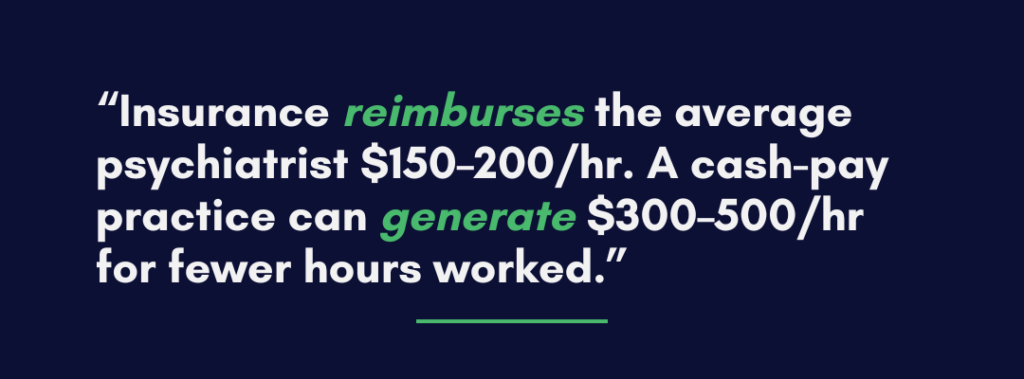
One of the primary ways they do this is by creating friction — short visit windows, prior authorization requirements, claim denials, documentation burdens that consume hours of your week without compensation. None of this is an accident. It is a design feature.
Understanding this matters, because a lot of psychiatrists who are unhappy in insurance-based roles have quietly internalized the dysfunction as their own failure. They wonder if they are organized enough, efficient enough, resilient enough. They look for better workarounds. They try to make the system behave more predictably.
But you cannot fix a system that was not designed to be easy for you. You can only decide whether to keep working inside it, or to build something outside of it.
That is the real decision in front of you.
3 Signs It’s Time to Leave Insurance
Not every frustration with insurance is a signal to leave. Some of it is the normal friction of practicing medicine in a complex system. But some of it is something different — a deeper misalignment that does not get better with time or adaptation.
Here are the three signs I see most consistently in the psychiatrists who are genuinely ready to make a change.
1. You are spending more time on administration than on patient care
Prior authorizations. Claim rejections. Chart documentation timed to billing codes rather than clinical usefulness. If you are routinely staying late or coming in early to handle paperwork that has nothing to do with your patients’ wellbeing, the model is not working. This is not a time-management problem. It is a structural one.
2. The way you are practicing does not match the way you were trained to practice
You went into psychiatry to think carefully about complex human beings. To build trust over time. To consider the whole person — their biology, their history, their relationships, their context. Fifteen-minute med checks do not allow for that. If you regularly feel like you are giving your patients a fraction of what they actually need, that is a meaningful signal.
3. You are staying for external reasons, not because you want to be there
This is the most important one. If the honest answer to “why are you still in insurance practice” is “because I’m afraid of what happens if I leave,” that is worth examining. Fear of income disruption, fear of patient abandonment, fear of what colleagues will think — these are all understandable. But they are not reasons to stay in a model that is actively harming your wellbeing and your patients’ care.
When You Should NOT Leave Yet
In the interest of a genuinely useful framework, I want to be direct about this: there are situations where leaving insurance is the wrong move right now. Not because it’s a bad idea in principle, but because the timing or the foundation isn’t right.
You should probably wait if:
- You have no financial runway. If you would be in a crisis within 60 days of losing your primary income, this is not the moment to make a full transition. The right first step is building financial stability, not leaping from a burning ship onto open water.
- You have not yet decided what you actually want to build. Leaving insurance is not a plan. It is the beginning of one. If you cannot answer the question “what kind of practice do I want to run and for whom?” you will likely recreate the same frustrations in a new model.
- You are in a state of acute burnout or emotional crisis. Big structural decisions made from the bottom of a burnout spiral often prioritize escape over intention. If you are in that place, getting some support and stabilization first will serve you better than a hasty exit.
- Your contract has non-compete clauses you haven’t had reviewed. This is not a reason to stay forever, but it is a reason to spend $300–500 on an attorney’s opinion before you give notice. Many non-competes are narrower, more negotiable, or less enforceable than they appear.
None of these mean “don’t go.” They mean “not yet, and here’s what to do first.”
A Simple Decision Framework
If you have been going in circles on this decision, here is a structure that tends to cut through the noise.
Ask yourself these four questions honestly. Write the answers down if you can.
1. What is the actual cost of staying?
Not just in income — in hours, in quality of care, in your energy, in your health. Most psychiatrists dramatically underestimate the cost of staying in a model that is not working. They focus on the risks of leaving and treat the risks of staying as the neutral baseline. They are not neutral. Burnout has a cost. Moral injury has a cost. Years of your career spent in a model you resent have a cost.
2. What would have to be true for leaving to feel safe?
This question is more useful than “should I leave?” because it surfaces the specific conditions you need rather than the abstract fear. Maybe it’s three months of expenses saved. Maybe it’s a part-time income source while you build. Maybe it’s one trusted colleague who has done it successfully. Get specific about what “safe” actually means for you.
3. What is your honest timeline if you do nothing?
If you stay in your current role for another two years, another five years — what does that actually look like? Most people find that when they are honest about this question, the “do nothing” scenario is significantly worse than they had been treating it. The status quo is not a safe choice. It is a choice with its own consequences.
4. What is the smallest possible next step?
You do not need to decide everything today. You need to decide one thing. That might be scheduling a consultation call to talk through your specific situation. It might be reviewing your contract. It might be calculating what your minimum viable income would look like in a cash-pay model. Pick one thing and do it this week.
What the Transition Actually Looks Like (It’s Not a Leap Off a Cliff)
One of the most persistent myths about leaving insurance psychiatry is that it requires burning everything down and starting over. It does not.
Here is a simplified version of how most psychiatrists in my program make this transition successfully:
Step 1: Set a transition date
If you are leaving an employed position, your last day is your date. If you are converting an existing insurance practice, pick a date three to six months out. That window gives your patients time to plan and gives you time to organize your panel and your systems. Indefinite timelines create indefinite procrastination.
Step 2: Audit your current panel
Before you notify anyone, look at your patient list through a business lens. Which patients are you actually reimbursed well for? Which ones are you working significantly harder for less? Which patients genuinely want the deeper, more integrative care you are moving toward? This audit often reveals that 40–60 percent of your panel is a poor fit for either the existing model or the new one — and that the patients who will follow you are often the ones you most wanted to keep anyway.
Step 3: Communicate honestly and generously
Your patient letter should not begin with your new fee schedule. It should begin with the truth: that the insurance model limits the quality of care you can provide, and that you are shifting to a model that allows for longer visits, more integrative options, and better continuity. Then clearly explain the timeline, the new fees, how patients can use out-of-network benefits, and how you will support anyone who needs to transfer care.
Patients are adults. They deserve honest information and the opportunity to make their own decisions. Most will respect the change, even if not all of them can follow you.
Step 4: Build in parallel, not in sequence
Roughly 80 percent of the psychiatrists I work with start their cash-pay practice while maintaining some part-time income — whether from their current employer, a per diem role, or a locum position. You do not have to wait until you have a full cash-pay panel to leave. You can reduce your insurance hours as your cash-pay practice fills in. This parallel approach dramatically reduces the financial risk and the psychological pressure of the transition.
For a deeper look at the mechanics of this process, How to Transition From Insurance to a Cash-Pay Practice walks through the six-step process in detail.
What About the Ethics of Going Cash-Pay?
I want to address this directly, because it is one of the most common concerns I hear — and one I carried myself early in my career.
The concern usually sounds like: “If I go cash-pay, I’m only serving wealthy patients. That feels selfish. That feels like I’m abandoning access.”
Here is my honest response.
A burned-out psychiatrist seeing 25 patients a day in 15-minute appointments is not providing excellent care to anyone, regardless of how the visit is billed. The insurance model’s affordability comes with enormous hidden costs to quality — for patients and providers alike.
Cash-pay psychiatrists often fill a gap that the insurance system actively cannot serve: complex presentations, integrative approaches, patients who have been poorly served by medication management alone. The care is different. Not just the billing.
And there are ways to build a cash-pay practice that expands access rather than restricts it — sliding scales for a limited number of patients, shorter lower-cost follow-up formats, group programs, and community education. Leaving insurance does not mean leaving your values at the door.
If this concern is one you’re sitting with, Is a Cash-Pay Psychiatry Practice Unethical? is a candid video on exactly this topic that might help you work through it.
What to Do Next
If you read this post and found yourself nodding through most of it, that is information. You probably already know the answer to the question at the top of this page. The question now is whether you are ready to act on it.
Here are three things you can do today, depending on where you are:
- If you are still in the “maybe someday” category: Read through the four decision framework questions above and write your honest answers. Even that exercise tends to produce more clarity than months of passive consideration.
- If you are leaning toward leaving but not sure how: Schedule a free consultation call with my team. We will look at your specific situation — your contract, your finances, your goals — and tell you honestly whether and how Dream Practice Academy could support you.
- If you are ready to start building the infrastructure of a cash-pay practice: The Private Practice Roadmap below is a good first step. It’ll help you identify exactly where you are and what your next move should be.
And if you want to understand what building a cash-pay practice from the ground up actually involves — the setup, the costs, the timeline — How to Build a Cash-Pay Psychiatry Practice is a good next read.
You do not have to figure this out alone. And you do not have to burn your practice down to build something better.
Want a clear, step-by-step plan for building your dream private practice (without the overwhelm)? Grab the free Private Practice Roadmap by answering a few quick questions below. It’ll help you get clarity on your next best steps, avoid common early mistakes, and start creating a practice that actually fits your life and values.